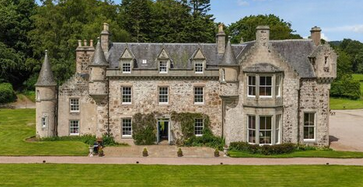
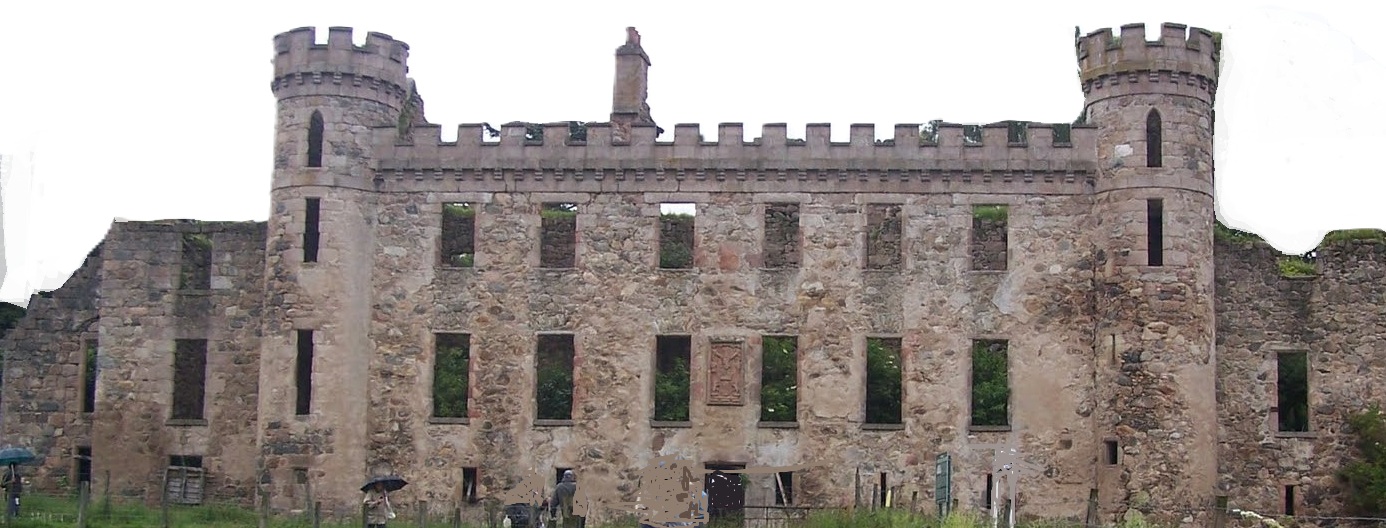
This is the proposed wording for the new information sign to be located at Fetternear. The existing sign is in poor shape and parts are unreadable. Therefore, the Leslie Global Diaspora Foundation has a funding project to replace the existing sign. Below is the proposed wording written by Dr. P. Dransart, the archaeologist who did an extensive “dig” on the site. Some of her writings about Fetternear are linked on this page:
https://lesliegdf.org/leslie-sites/
The funding for the Fetternear project has gone quite well with $550 received of the #1,375 needed. Link to Donation Page
FETTERNEAR: BISHOP’S PALACE IN THE MEDIEVAL DIOCESE OF ABERDEEN AND POST-REFORMATION MANSION OF THE LESLIES OF BALQUHAIN
In a charter of 1157, Pope Adrian IV confirmed that the township and parish church of Fetternear, situated about a mile east of the palace, belonged to the bishops of Aberdeen.
As you read this sign, you are standing inside the former bishop’s palace, which was nearly completely surrounded by a moat 6 m wide, with water draining through a ditch into the Marshes Burn. In the 13th century, the palace was protected by a timber palisade, later replaced by a stone wall. Visitors entered the palace over a timber trestle bridge near the south-eastern corner of the moated area, from a route leading directly from the church.
During the 13th and 14th centuries, the bishop’s writing-room was behind this sign and, beyond it, a stone-built chapel. The great hall was probably situated where the ruins of the present-day mansion stand. Kitchens were located in the south-west of the moated area, west of the current drive leading to the mansion.
After the Protestant Reformation (1560), the estate of Fetternear was granted to the Leslies of Balquhain. By 1571, they had built a tower-house with stair tower, visible on the right of the ruin. In the 17th century, members of the Leslie family became counts of the Holy Roman Empire. Above the front door is the armorial of the third count, Patrick Leslie, and his second wife, Mary Irvine of Drum. Their monograms appear on a stone higher up the façade, below the letters IHS, a Christogram of the name of Jesus Christ, and MRA, the monogram of Mary, Queen of the Angels. Further additions to the mansion were made in 1818, including the battlements. In the 1840s, a Victorian range was added on the west of the mansion. The building became a ruin after a fire in 1919.
2 responses to “Fetternear Bishop’s Palace”
I first saw the sign many years ago and then again in the summer of 2025. It is in sad shape, difficult to read, and in great need of replacement. Fetternear Bishop’s Palace is a significant Leslie sight. Please help the Leslie Global Diaspora Foundation replace it.
Christine Johnson
As Fetternear was important to the Bishops of the Catholic Church of Scotland and Rome, as well as a most prominent residence of the Barons of Balquhain, it is extremely important to acknowledge its history and preserve its surroundings in perpetuity. Thank you to the Leslie Global Diaspora Foundation for spearheading this effort.